
Arrest Records Across Texas
A Texas arrest can produce records in several systems. The arresting agency writes the incident and arrest report. A local booking facility records intake, fingerprints, charges, bond, housing, and release. The prosecutor and court later create charging and case records. Texas DPS may receive a fingerprint-supported arrest segment for the Computerized Criminal History system. If a state sentence follows, the Texas Department of Criminal Justice creates a correctional record.
Those records answer different questions. A current jail roster can show where a person is held today. An agency report describes the event, subject to public-access limits. A court file shows whether prosecutors filed a case and how it ended. The public Texas DPS name search is narrower: it disseminates reported convictions and deferred adjudications with associated arrest data that Texas law permits Texas DPS to release. It is not a live statewide booking feed.
A Texas Arrest Creates Four Records
The first record is the law-enforcement report. It can identify the agency, report number, time, place, alleged offense, and facts the agency records. The second is the booking entry, which tracks custody, a booking number, intake charge, bond, housing, and release. The third is the court file, created after magistration or a filed charge. The fourth is the Texas criminal-history cycle, built from fingerprint, prosecutor, and disposition submissions.
One system may update while another lags. A booking charge may change after prosecutor review. A Texas roster entry may disappear after release, although the underlying government record remains subject to retention and access law. A Texas DPS record may lack the outcome if the later report was rejected, delayed, or not linked. Compare sources before treating any one entry as complete.
- Booking
- The jail intake record, not a finding of guilt.
- SID
- The state identification number used in the fingerprint-supported Texas history system.
- TRN/TRS
- The tracking incident number and suffix that connect arrest, prosecutor, and court reporting.
- Disposition
- The court outcome for a charge, such as conviction, dismissal, acquittal, or deferred adjudication.
Note: The same Texas arrest can have different update times and public fields in each official record system.
From Texas Arrest to Rap Sheet
For a Class B misdemeanor or more serious offense, the arresting Texas agency fingerprints the person and starts the tracking transaction. Electronic Arrest Reporting sends identity, arrest data, and fingerprint images through the state biometric system into CCH. Texas DPS will not accept that electronic arrest submission without fingerprints. Prosecutors and clerks later report their decisions and dispositions under the same tracking structure.
Data flow: Arrest › Booking › Fingerprint Submission › Texas DPS Repository Entry
Texas law generally requires covered arrest data to reach Texas DPS within seven days. Other Chapter 66 information generally must be reported promptly and no later than 30 days after the agency receives it. Even with those duties, reporting can be incomplete. The January 2026 Texas DPS compliance report measured adult disposition completeness at 73% for the studied 2024 charges already reported to CCH. That figure does not mean 73% of all Texas arrests were reported. It measures linked outcomes among reported charges.
Note: A missing Texas DPS disposition may reflect reporting or linkage trouble, so check the originating court before judging the arrest outcome.
Texas Arrest Agencies and Custodians
Municipal police hold their own incident and arrest reports, while the receiving jail keeps booking data. County sheriffs enforce laws and warrants and commonly operate the Texas county jail. Constables serve warrants and process. Texas DPS Highway Patrol and Texas DPS Criminal Investigations hold their own state-agency reports. Campus and school-district police maintain records for events within their authority. TDCJ investigators handle prison-related matters, not ordinary Texas bookings.
Send a request under the Texas Public Information Act to the agency that created or holds the specific record. Ask the arresting agency for its report. Ask the booking facility for intake and release data. Ask the clerk for the formal case papers. Active-investigation material, juvenile records, victim details, and protected identifiers may be withheld or redacted. The Attorney General does not act as a warehouse for another agency’s records.
- Use the report number, event date, place, and full name when known.
- Request electronic copies and a list of any withheld or redacted fields.
- Ask the arresting agency to correct arrest facts it reported incorrectly.
- Obtain a certified disposition from the court to repair a missing Texas DPS outcome.
Note: Send each Texas arrest request to the actual custodian, since one agency need not possess another agency’s record.
Texas Arrest Lookup Options
Recent Texas arrest data is local first. Start with the likely Texas county and receiving jail, especially near city or Texas county boundaries. The Texas county roster may show current custody, charge, bond, and release. Then request the incident report from the arresting agency. Search the appropriate court after prosecutor review. Texas DPS public CCH becomes useful for reported public outcomes, but it should not be used as a real-time arrest tracker.
- Identify the likely arrest place, date, agency, and receiving jail.
- Open the directory of all 254 Texas counties and use the official local jail or sheriff route.
- Request the incident or arrest report from the agency and search the clerk after a case is filed.
- Compare the booking allegation with the court disposition. For current state or federal custody, switch to the matching locator.
A no-hit result can mean release, transfer, a name mismatch, reporting lag, a confidential record, or a different facility. Try full-name variants and date of birth where the official form accepts them. Call the published facility line when its roster is absent or stale. The Texas DPS public search is an account-and-credit channel for the statutory public slice. For a fuller review of your own Texas history, follow the FAST fingerprint personal-review instructions. Agencies may also accept mail, email, or an official request portal, so use the custodian’s stated channel.
Texas Custody Locator Routing
Texas has three custody levels, and each needs a different search. County jails chiefly hold people before trial, on local sentences, or on warrants and detainers. TDCJ holds people transferred after qualifying state judgments. Federal Bureau of Prisons custody is separate. Notification tools can add alerts, but coverage and participation should be checked.
| Texas custody channel | Best use | Main fields or limit |
|---|---|---|
| County jail roster | Recent booking and pretrial custody | Local fields may include booking, charge, bond, court, and release. |
| TDCJ Online Inmate Search | Current Texas state incarceration | Name with first initial, TDCJ number, or SID; not Texas county jail data. |
| Federal BOP locator | Federal sentenced custody | Separate federal system; no Texas county booking file. |
| Texas VINELink | Participating custody searches and alerts | Verify that the agency participates and confirm data with the facility. |
| TDCJ IVSS | Custody and parole notification | Confidential alert enrollment; Texas county integration is not universal. |
The official TDCJ Online Inmate Search is free and designed for current TDCJ custody.
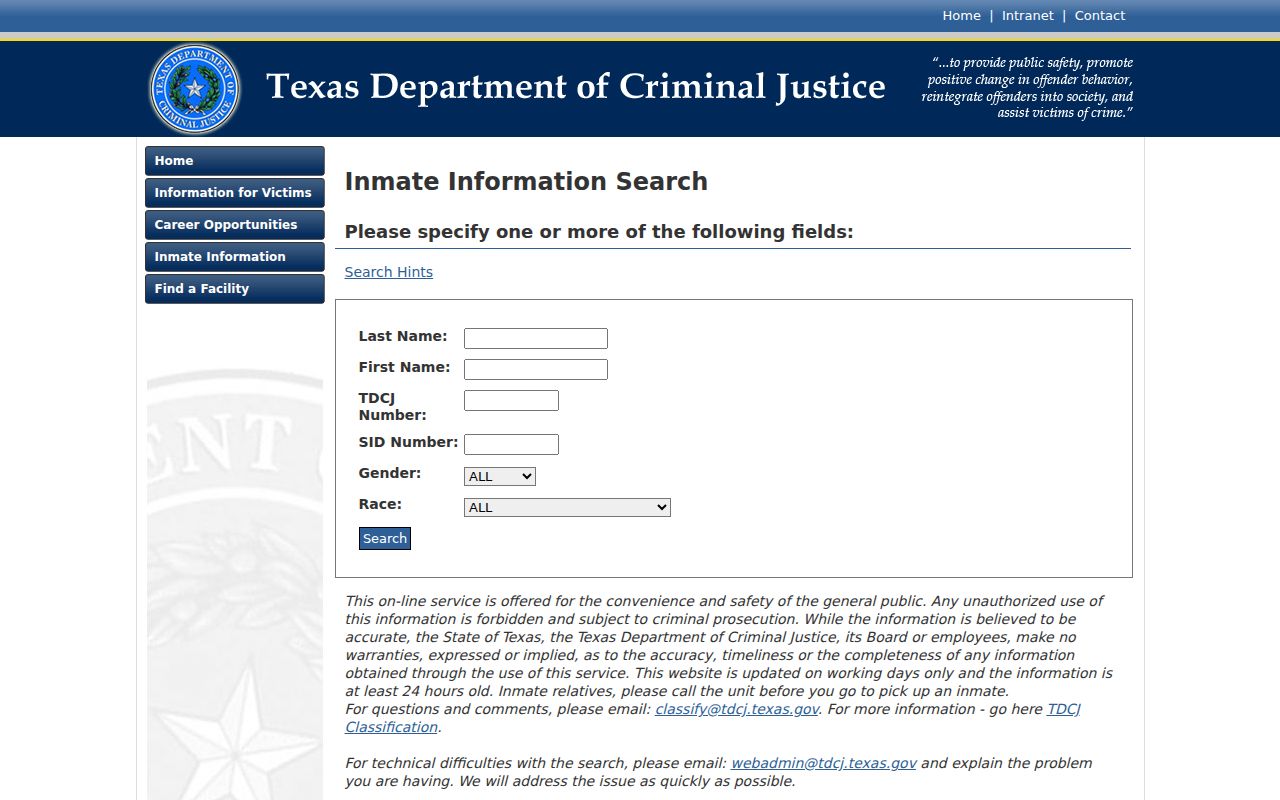
Its fields include name, TDCJ number, SID, gender, and race. Results can show facility, sentence and projected-release data, but they do not function like a Texas county booking sheet with bond and a current local court date.
Fields on a Texas Arrest Record
A Texas arrest record can carry identity data, event details, alleged charges, custody fields, and tracking identifiers. Public views differ by custodian. A local jail may show a booking number and bond. An agency report may contain a narrative that is partly withheld during an active case. The Texas CCH cycle can connect the arrest to prosecutor and court segments, while a public Texas DPS result is limited by state dissemination law.
| Name & Identifiers | Names or aliases, date of birth, sex, race, descriptors, SID, and tracking identifiers as the public channel permits. |
|---|---|
| Arrest Event | Arresting agency, report number, date, time, location, and warrant number when recorded. |
| Charges at Booking | The allegations used at intake, which may differ from the later filed or disposition charge. |
| Booking & Custody | Booking number, facility, intake, housing, release, and an optional photograph. |
| Court & Release | Magistrate, cause number, court date, bond type or amount, release, and detainer when supplied. |
| Final Outcome | Usually comes from the clerk’s judgment or disposition, not from the booking entry alone. |
The broader TDCJ offender-information channels include online, email, and phone routes for state custody.
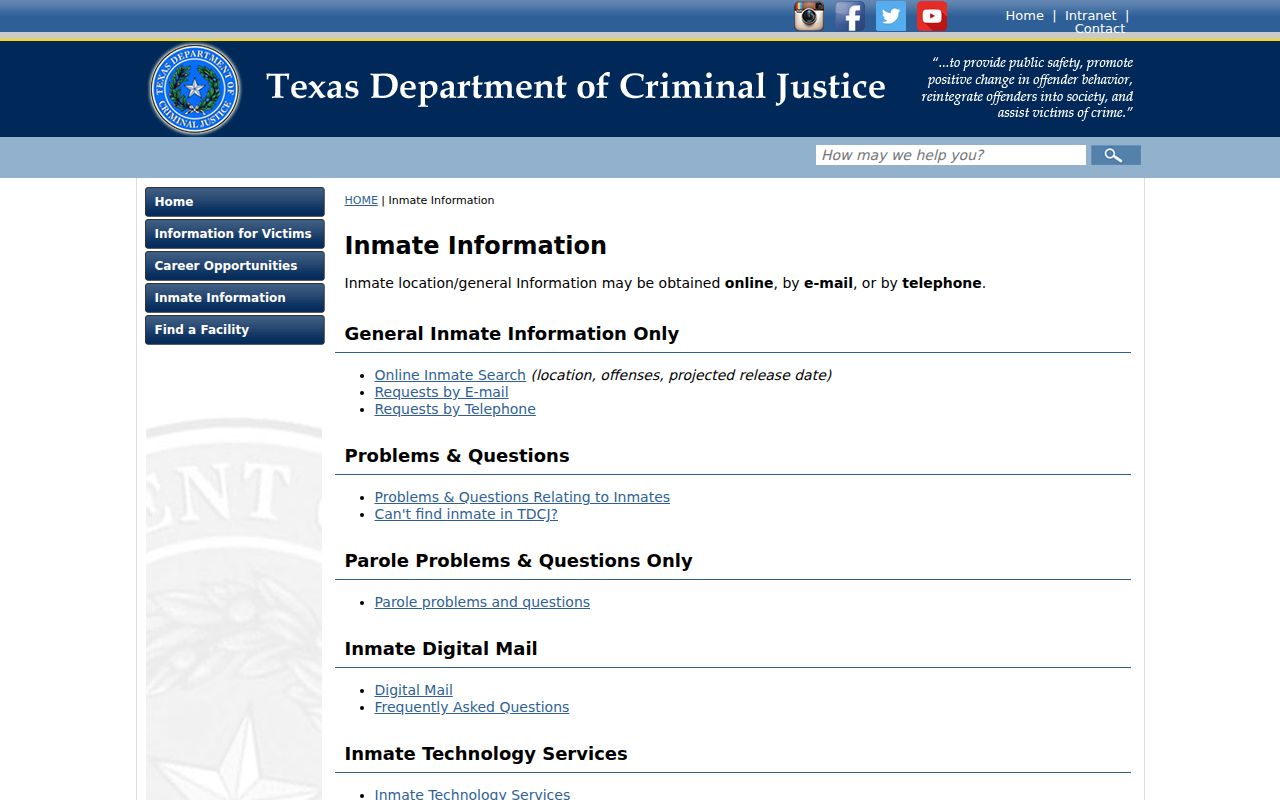
Use those channels after a state transfer. A recent local detainee may have no TDCJ result because the Texas county jail and state prison systems serve different stages.
Texas Arrest Custody Notifications
Texas VINELink can provide custody searches and notification events for participating agencies. It is useful when a person needs updates instead of a one-time roster view. Participation still matters, and a facility should confirm urgent custody information. A notification service does not replace the case docket or prove the final charge.
The official Texas VINELink interface supplies the statewide entry point for participating custody information.

The system can bridge the gap between repeated manual searches, but local roster coverage and data timing should still be verified with the holding facility.
Texas IVSS County Coverage
The TDCJ Integrated Victim Services System covers custody, parole, and mandatory-supervision information with confidential alert enrollment. IVSS Counties launched in September 2025 to connect participating jail and court information with TDCJ after transfer. The research does not support assuming that every Texas county participates. Use the Texas county route when a local event is missing.
TDCJ provides the official IVSS enrollment and information portal.
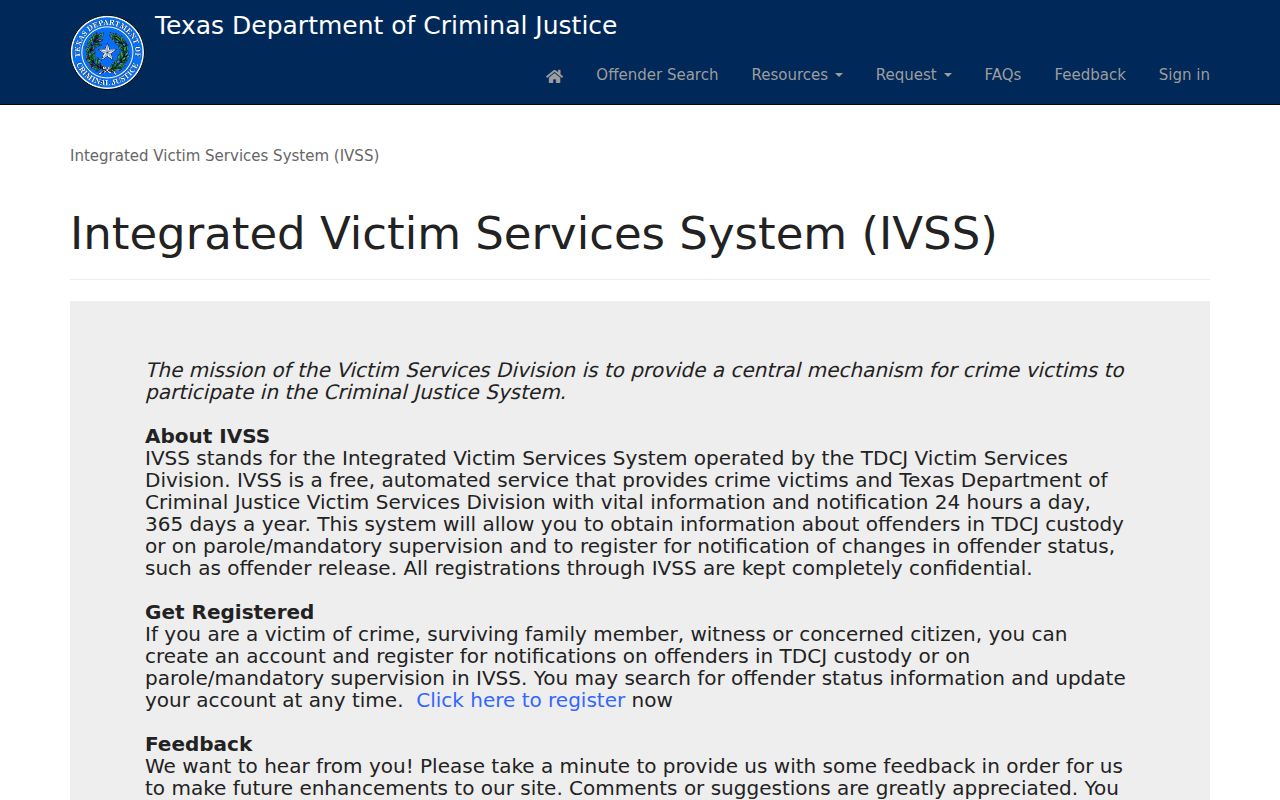
IVSS is a notification program, not a public rap sheet. It follows custody and supervision events that are relevant to its service and coverage.
Texas Arrest Mugshot Access Rules
A Texas booking photograph is not guaranteed to appear online. The holding agency decides release under the Texas Public Information Act and other applicable law. Active-investigation or prosecution exceptions, juvenile confidentiality, court orders, and protected personal data can limit access. Attorney General Open Records Decision 616 explains that mugshots are not automatically identical to confidential criminal-history information, but release remains fact-specific.
Texas Business and Commerce Code Chapter 109 regulates some downstream publishers of criminal-record and booking-photo information. It sets accuracy and dispute duties, bars correction fees, and restricts publication of expunged, nondisclosed, or confidential juvenile material. It does not require a sheriff to post booking images. An official records request should go to the agency that holds the photograph. Never infer guilt from an image, and do not republish it.
A Texas mugshot records an intake moment. It does not show whether prosecutors filed a charge or whether a court convicted anyone.
Texas Arrests and Convictions Compared
An arrest is a law-enforcement event based on an allegation and legal authority to take someone into custody. A conviction is a court judgment of guilt after a plea or verdict. Texas public systems treat them differently. A local booking may be visible before any case is filed. The public Texas DPS name search generally releases reported convictions and deferred adjudications with associated arrest data under Government Code Section 411.135, not every arrest held by the repository.
| Arrest record | Conviction record | |
|---|---|---|
| Created by | Arresting agency and booking facility | Texas court judgment, then reported to Texas DPS |
| What it establishes | Custody or arrest occurred on an allegation | Guilt was adjudicated by plea or verdict |
| Best source | Agency report and Texas county jail record | Signed court judgment and certified disposition |
| Public access | Depends on custodian, PIA exceptions, and record status | Court access plus the authorized Texas DPS public product |
| Possible relief | Qualifying Texas arrest records may follow Chapter 55A expunction | Relief is narrower and depends on the specific outcome and statute |
Note: A Texas arrest entry without a disposition is not proof of guilt; verify the Texas county court file before drawing conclusions.
Expunction under current Chapter 55A can direct listed holders to remove qualifying arrest records. An order of nondisclosure is different. It limits ordinary public dissemination but does not destroy the record and preserves access for agencies named by law. After relief, check the originating docket and then review your own fingerprint-based Texas DPS record to confirm the change.