
Texas Sex Offender Checks
The Texas Public Sex Offender Registry is the official statewide public search run by Texas DPS. It combines the public fields that Texas registration authorities, courts, TDCJ, TJJD, and other justice agencies submit under Texas Code of Criminal Procedure Chapter 62. Duties may arise from a reportable conviction or adjudication, a court condition, or an equivalent duty from another jurisdiction. Some juvenile and court-restricted information remains outside the public view.
A Texas registry entry is regulatory notification data. It is not a new charge and it is not the full court file. Search results should be read with the Texas profile's source and verification fields. Texas DPS warns that names and other alphanumeric details can point to the wrong person. Fingerprints are the only positive identity link. The official search is free and does not require an account.
The official Texas registration program overview shows how Texas DPS and local authorities divide the work.
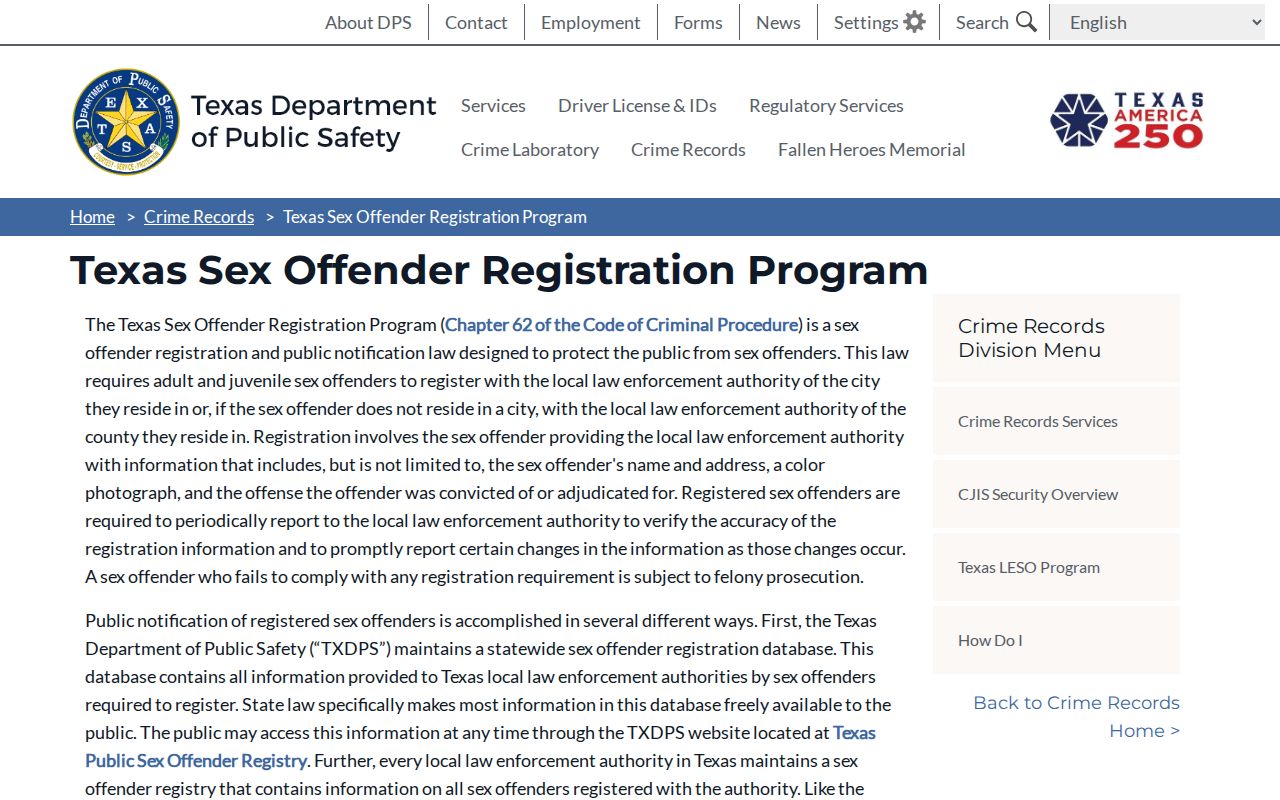
That division matters because the statewide Texas registry profile depends on the latest verified Texas registration report.
Texas Registry Map and Alerts
The public Texas registry map begins with an address geocoder. The chosen place sets the map location and the current map extent controls what appears. There is no public mileage-radius selector on that map. Turn on Include Unmapped. Some records do not plot because an address was supplied in a form the geocoder cannot place, and a missing pin does not mean a missing registration record.
The official Texas registry map pairs the map with a collapsible results drawer and public notices.
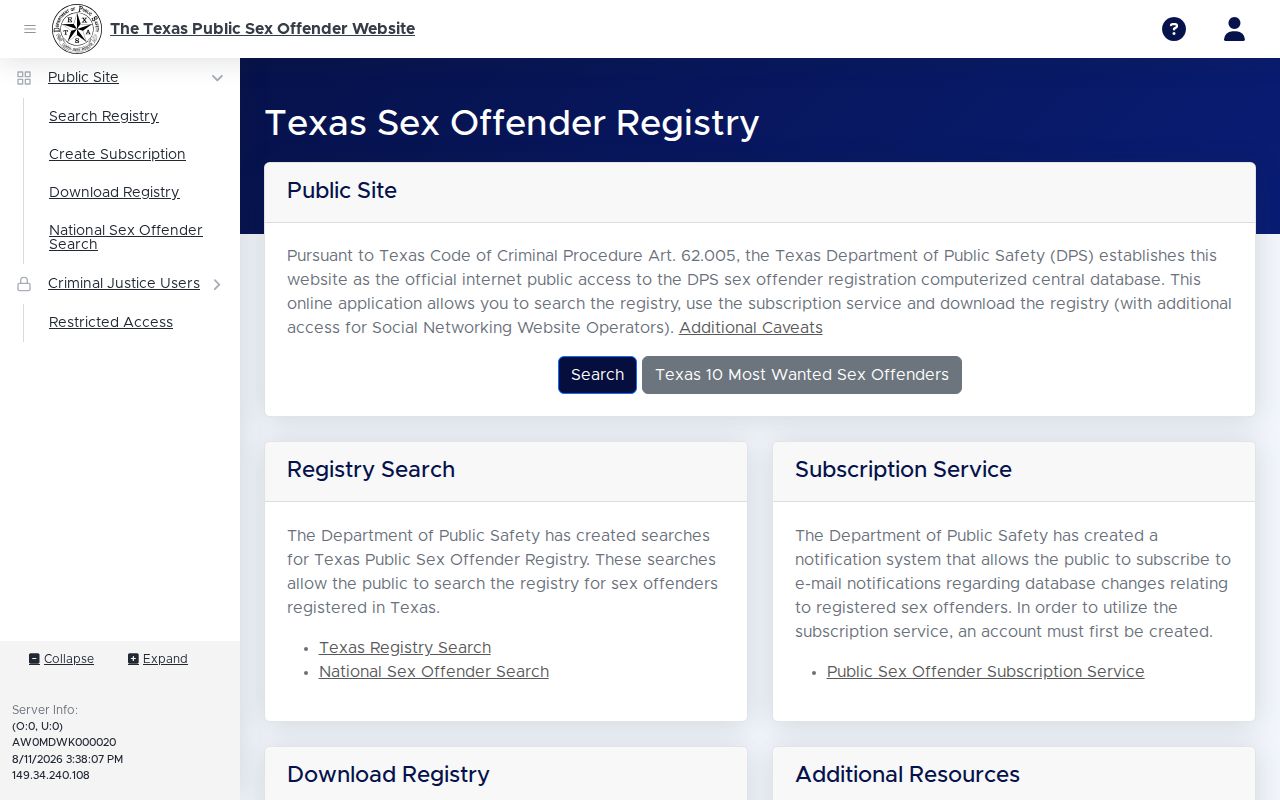
Use map results as a location aid, then open the full Texas registry profile and check the reported address, event date, and Texas verification agency.
A separate free Texas registry subscription service requires an account. It supports alerts tied to a person, place, ZIP code, or campus. Texas DPS describes nightly email when tracked information changes, including address moves, institutional status, removal, or campus data. Exact selectable address-radius values remain behind the account gate, so choose only options shown during enrollment.
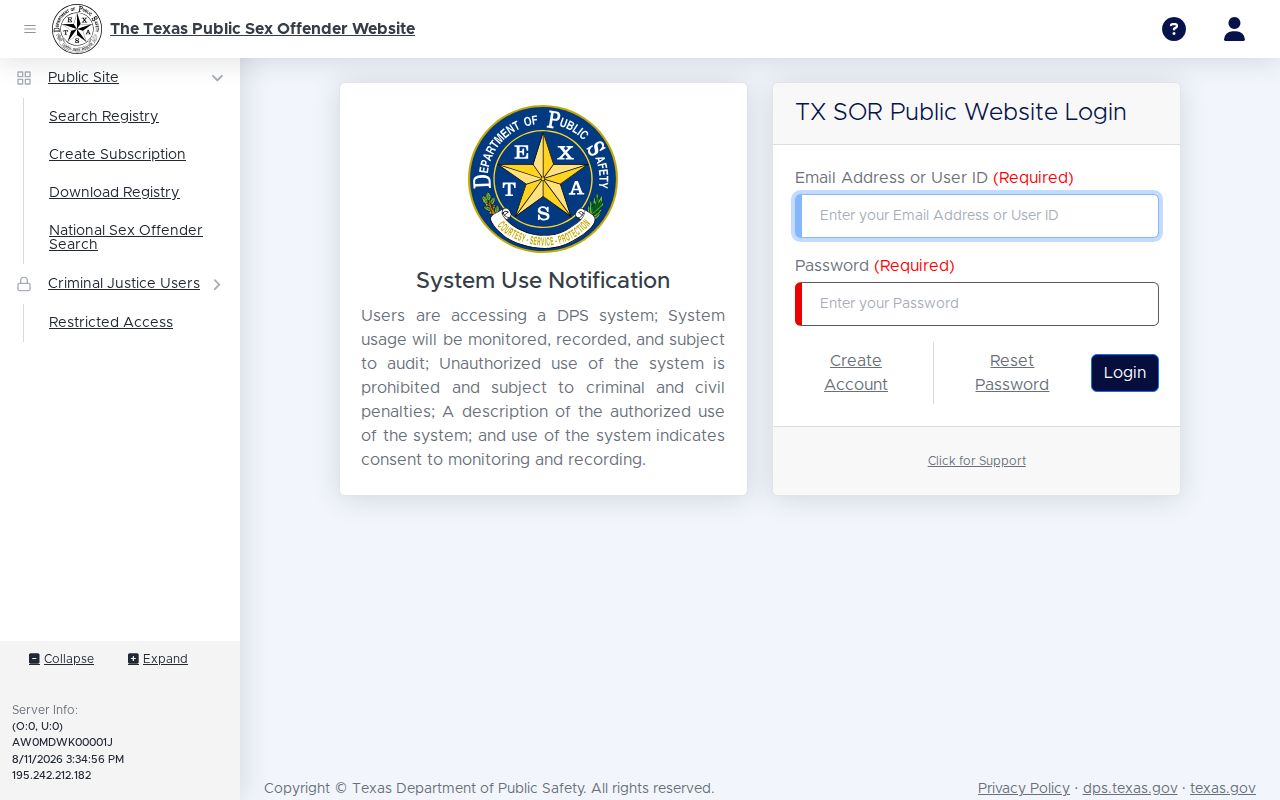
Subscriptions support ongoing community awareness, but they do not replace a fresh Texas profile review or direct verification.
Texas Public Sex Offender Registry Search Steps
The Texas Public Sex Offender Website supports more than a basic name query. Pick the mode that fits the facts already known. Name searches require both first and last name. A birth date can narrow the result. Place searches include map address, full street address, five-digit ZIP, county, and institute with a dependent campus choice.
- Open the official Texas DPS search and acknowledge the identity and lawful-use notices.
- Choose name, map, address, ZIP, county, or institute and campus. Enter the most exact data available.
- Review mapped and unmapped results, then open each possible Texas profile. Compare the photo, aliases, birth dates, descriptors, offense, and verification details.
- Contact the Texas verification authority shown in the Texas profile when information appears stale or wrong. Use a subscription only after the current entry is understood.
| Field Label | Type | Required | Notes |
|---|---|---|---|
| First and Last Name | Text | Yes | Both names are required; birth date is optional. |
| Map Address | Geocoder and map | For map use | Select a place or submit manual text; no public radius selector. |
| Street, City, ZIP | Text | Yes | Street number, street name, city, Texas, and ZIP form the address query. |
| ZIP Code | Text | Yes | Exactly five digits. |
| County | Dropdown | Yes | Includes all 254 counties and an UNKNOWN choice. |
| Institute and Campus | Dependent dropdowns | Yes | Campus choices load after the institute selection. |
| Email Alerts | Account signup | No | Person, place, ZIP, and campus subscriptions are separate from public search. |
The Texas search form displays the current set of controls.
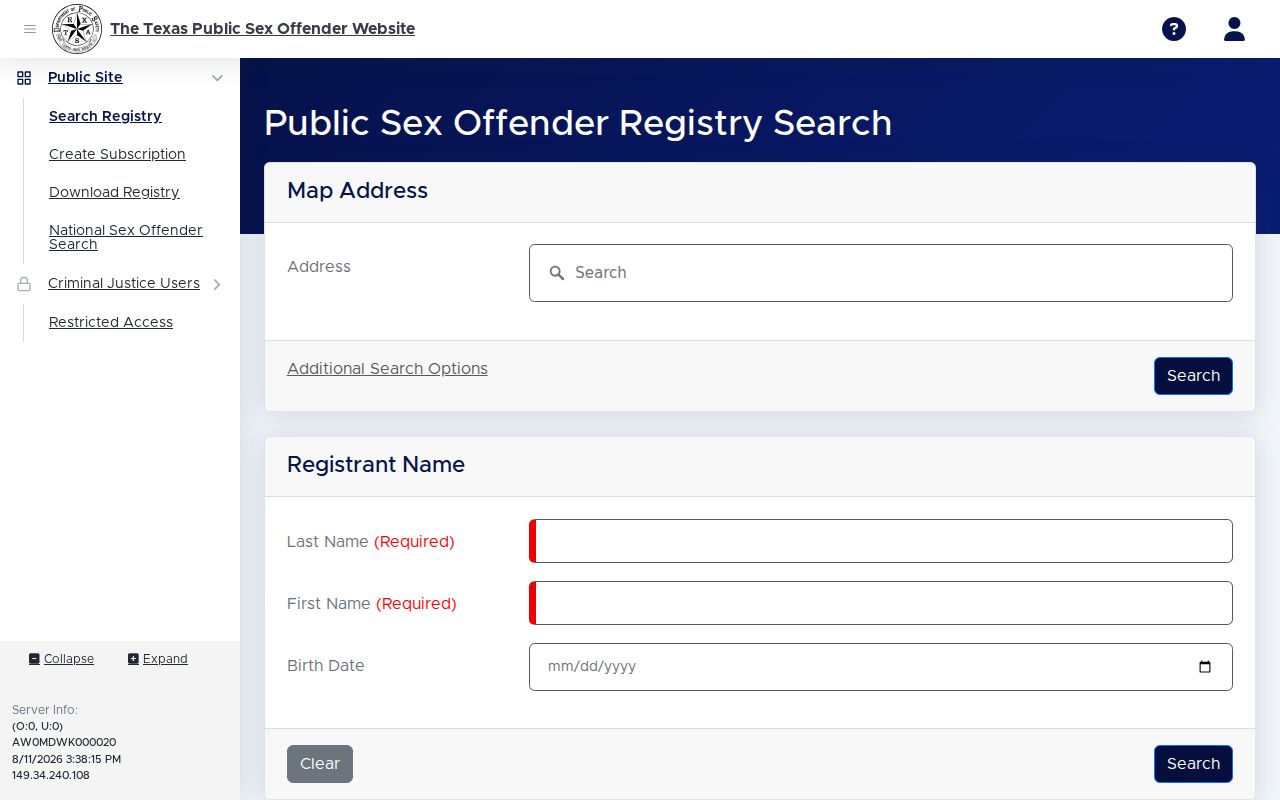
Its institute and campus search is a distinctive Texas option for higher-education location checks.
Texas Registry Verification Chain
Registration occurs face to face with a Texas registration authority. A person who lives within a municipality generally reports to its police chief's office. Outside a municipality, the Texas county sheriff is the usual authority, although a Texas county may create a central countywide registrar. Texas DPS then aggregates qualifying public fields. Readers can use the directory of Texas counties to reach the Texas county layer named by a Texas profile.
Chapter 62 sets several update duties. An intended move must be reported in person before the change, and the new Texas registration authority receives proof after a Texas move. Changes to a name, online identifier, physical health, work, or education status also have reporting deadlines. A person with no fixed address reports a geographic location and checks in more often. The Texas profile's event history and verification date help show when the local source last acted.
Note: A stale-looking address is a reason to contact the named authority, not a basis for confrontation or an unsupported public claim.
What a Texas Registry Profile Lists
A Texas profile places identity, location, offense, and compliance context on one record. Read the fields together. A photograph can be current or historical, and the reported date matters. An exact reported address may be public, yet event flags can state that information was not verified. The projected registration-ending date gives a system estimate, while the governing judgment and Chapter 62 control the legal duty.
| Name and Aliases | Reported names, alternate names, and birth dates used to distinguish candidates. |
|---|---|
| Photo and Description | Current and older photos with reported dates, plus sex, race, ethnicity, height, weight, hair, eyes, and shoe details. |
| Reported Location | Address or location, its designation, event history, and the local verification agency. |
| Offense Details | Jurisdiction, registration basis, statute, victim age and sex, disposition, and punishment or supervision facts. |
| Risk and Duration | Texas risk level, projected ending date, and verification requirement, which must not be read as one field. |
| Other Public Data | Reported vehicle, education, campus, and occupational-license fields when supplied. |
Article 62.005 keeps Social Security and driver-license numbers, phone and online identifiers, employer details, law-enforcement-only fields, and victim-identifying facts from the public profile. The list is broad, not unlimited.
Texas Registry Risk and Duration
Texas risk labels and Texas registration terms answer different questions. Level 1 means a low assessed danger and a low likelihood of continuing. Level 2 means moderate danger and possible continuation. Level 3 reflects serious danger and an expectation of continuation. A high-risk label triggers wider notice, including English and Spanish postcards under stated conditions. It does not by itself create a lifetime term.
Duration comes from Article 62.101 and the offense or adjudication facts. Listed sexually violent and other specified circumstances lead to lifetime registration. Many other adult cases follow a term ending ten years after the latest applicable release, supervision discharge, or deferred-adjudication dismissal and discharge. Juvenile and out-of-jurisdiction rules have their own calculations. Texas risk levels also differ from federal SORNA Tier I, II, and III labels.
The official Texas DPS registry FAQ addresses reporting, duration, and public access.
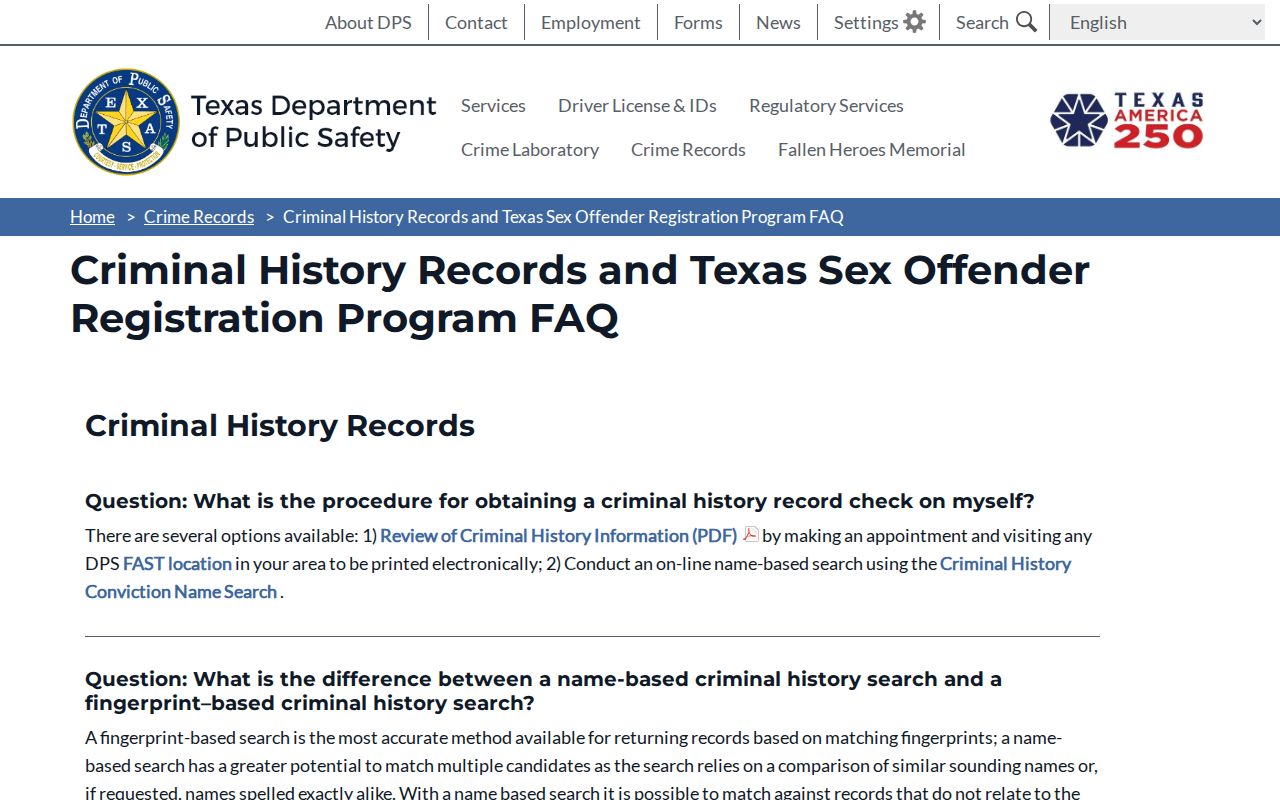
The practical lesson is simple: read the risk label, projected end date, offense basis, and verification rule as separate facts.
Registry Levels and Requirements in Texas
Verification frequency also comes from statutory circumstances rather than the public risk label alone. Most registrants verify annually. A person with two or more sexually violent offenses generally appears in person every 90 days. Current civil-commitment rules distinguish a center resident, who verifies at least annually, from a civilly committed person elsewhere, who generally verifies every 30 days. Older summary language can miss that distinction.
| Texas Status | Duration | Typical Verification |
|---|---|---|
| Level 1, Low | Set by Article 62.101 facts, not the level | Usually annual unless another rule applies |
| Level 2, Moderate | Ten-year or lifetime rule may apply | Usually annual unless another rule applies |
| Level 3, High | Ten-year or lifetime rule may apply | Level triggers broad notice, not its own schedule |
| Two or More Sexually Violent Offenses | Usually lifetime under the statute | Every 90 days in person |
| Civil Commitment | Usually lifetime due to the case basis | Annual in a center; every 30 days elsewhere |
Eligible people with a single offense may seek early termination through a certified Individual Risk Assessment and a motion in the sentencing court. Texas DPS removes an expired duty after verification. Neither step can be inferred from a color or level alone.
Texas Registry Residency Rules
Texas Chapter 62 does not impose one blanket statewide school or park distance on every registrant. Supervision terms can create child-safety zones. Cities may also adopt local rules. A general-law municipality has specific authority to set a distance up to 1,000 feet, with statutory defenses, exemptions, and grandfathering. Residence questions therefore require both the person's supervision status and the current rule of the city involved.
Community notice is more uniform in defined high-risk cases. For a Level 3 move or release, Texas DPS sends English and Spanish notice to qualifying nearby non-post-office-box addresses. The range is one mile in areas without subdivisions or three blocks in subdivisions. School notice applies only when statutory conditions are met. Local authorities may add meetings, posts, print distribution, newspapers, or specialized web notices.
Note: A map pin cannot resolve a Texas municipal ordinance, supervision condition, or grandfathered residence; verify each with the responsible local authority.
Texas Registry Export and NSOPW
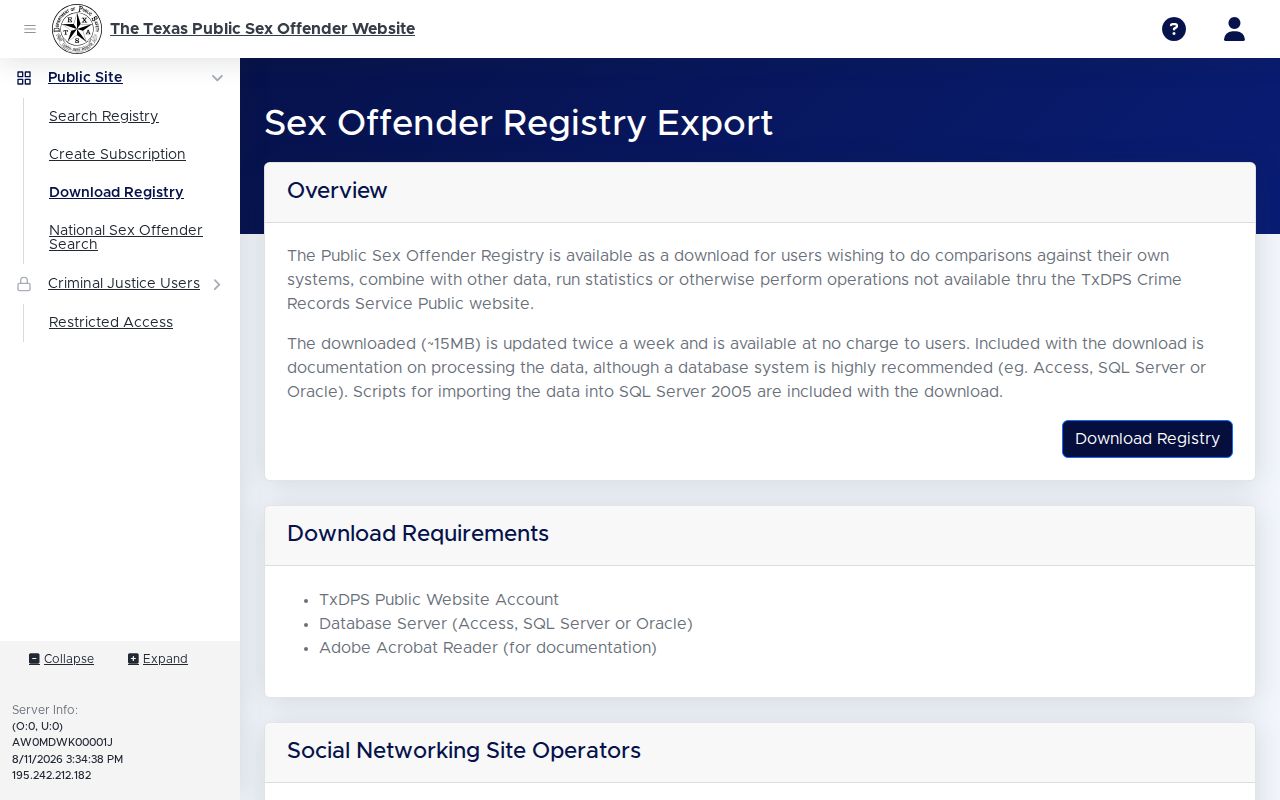
Texas offers a free account-gated bulk export updated twice each week. It is meant for users who truly need the statewide dataset and can work with database software. Preserve the download date because the file changes. A bulk copy does not improve identity matching or make withheld data public, and secondary users remain responsible for lawful matching and context.
The Texas registry export page states the account and update terms.
For a cross-state check, the U.S. Department of Justice National Sex Offender Public Website searches participating jurisdictions. Its name and location controls are useful when Texas may not be the only relevant state. Return to the Texas profile and its local source when a result needs Texas-specific verification.
Note: Preserve the update date for any Texas export because the live Texas registry changes and a saved file becomes historical.
Using the Texas Public Sex Offender Registry Lawfully
The Texas registry exists for public safety awareness. It does not grant permission to threaten, harass, stalk, injure, retaliate, or publish unsupported claims. Ordinary criminal and civil law still applies. Texas Penal Code Section 42.07 addresses harassment, and misuse tied to another offense can carry added consequences. A listed person, family member, neighbor, or local official should never be placed at risk because of a search result.
Suspected noncompliance belongs with the local registration police department or sheriff identified by the record. Emergencies go to 911. Accuracy questions also start with that source. Texas DPS maintains the statewide system, but it does not personally verify every address in every Texas community.
Texas also changed repeat failure-to-register punishment through HB 2407, effective September 1, 2025. Chapter 62 grades noncompliance by the underlying registration duty and increases consequences for repeat violations or fraudulent identifying information. That enforcement rule concerns a registrant's duties. It does not expand what a member of the public may do with Texas registry data.
Misuse can be a crime. Texas registry information supports awareness, not harassment, vigilantism, threats, injury, unlawful discrimination, or any act that breaks criminal or civil law.
Use the entry as a prompt for calm verification. Check the photograph and descriptors, note the verification date, read the offense and duty fields, and contact the proper authority when a material fact remains unclear.