
Texas DPS at a Glance
The Texas Department of Public Safety Crime Records Division is the state repository operation and the Texas control point for major state and national justice information programs. Texas Government Code Section 411.042 gives Texas DPS identification and records duties, while Code of Criminal Procedure Chapter 66 sets the reporting structure for the Computerized Criminal History system, usually called CCH.
Within the division, the Criminal History Record Information Services Bureau handles CCH data control, reporting support, Error Resolution, expunction processing, and sex-offender record operations. Access and Dissemination supports the public site, FAST, IdentoGO, FACT, and account issues. Biometric Services runs the Multimodal Biometric Identification System. Other units manage compliance, training, UCR statistics, justice communications, and CJIS security.
The Texas DPS Crime Records Division overview shows this broader program structure.

CCH is one major function inside that division, not a copy of every police report, jail file, or court document in Texas.
Texas DPS Repository Milestones
Texas DPS was created in 1935, but the current repository reflects decades of technical change. The Legislature funded an automated fingerprint system in 1989, and Texas DPS implemented it in 1991. A Criminal History Reporting Compliance and Training Unit followed in 1992. Juvenile criminal-history data entered CCH beginning in 1996, subject to its separate access rules.
Online access expanded in 2001. FAST brought a statewide electronic fingerprint network in 2006. The 2016 biometric upgrade added broader fingerprint, image, iris, and mobile capabilities, and FACT began FBI Civil Rap Back participation in 2018. Crime Records became a stand-alone Texas DPS division in January 2021. Through each change, the key design stayed the same: local agencies create records, biometric identity ties arrest cycles together, and later Texas county action updates the state file.
Note: Texas participates in the FBI Interstate Identification Index, but the FBI's current status list does not classify Texas as a National Fingerprint File state.
What Checks Texas DPS Offers
Texas DPS products differ in access, identity assurance, and scope. The public Criminal History Conviction Search is a paid name query for convictions and deferred adjudications that Section 411.135 allows Texas DPS to release. CR-42 returns the same public slice by mail. The CR-63 personal review uses fingerprints and is the correct Texas path for inspecting one's own fuller file. FACT is restricted to entities with statutory authority and is not a public people search.
| Product | Who May Order | What It Returns | Cost |
|---|---|---|---|
| Public Conviction Search | Any public account holder | Reported public convictions, deferred adjudications, and associated arrests | $1 initial query credit, plus card purchase charges |
| CR-42 Mail Search | General public | Same Section 411.135 public slice; certification may be requested | $10 per name |
| CR-63 Personal Review | The subject or authorized representative | Fingerprint-linked Texas CHRI for self-review | $25 total |
| FAST Hard Cards | Person needing two ink cards | Two fingerprint cards, not a history result | $20 at the stated Texas DPS channel; local capture may vary |
| FACT Texas and FBI | Statutorily authorized FACT entity | Restricted fingerprint result for the authorized category | $37 base through September 30, 2026; scheduled increases apply |
The Texas DPS public search instructions describe credits, matching, and the public product's limits.

Current help pages conflict on whether opening a complete record can consume another credit, so check the live checkout text before opening results.
Texas DPS Name and Fingerprint Checks
A name query is a candidate search. The public portal starts with first and last names, can use a middle or maiden name and full or partial birth date, and expands combinations through Soundex and other variants. A no-hit result only means no statutorily public Texas DPS CCH matched the submitted details. It does not prove that no Texas arrest, nonpublic record, unmatched identity, or local case exists.
Fingerprint personal review answers a different question. FAST service code 11FT12 links the submitted prints to the subject's Texas file. That makes it the sound route for checking one's own identity-linked record and preparing a challenge. It still does not produce Texas county pleadings, police narratives, or docket images. Those documents belong to their originating offices.
The public search and a fingerprint review should never be described as interchangeable. Texas DPS itself says fingerprints are the only positive identity match.
The Path Into the Texas DPS Repository
A reportable Texas arrest begins with a local law-enforcement agency. For covered offenses, fingerprints and an arrest segment move to CCH with a tracking incident number and suffix. The Texas DPS biometric system identifies or creates a State Identification number, rejects poor submissions for repair, updates CCH, and forwards proper data to FBI systems. Prosecutor and court segments later return through electronic disposition reporting and use the same incident identifiers.
Data flow: County Booking › Fingerprint Submission › Texas DPS CCH › County Disposition Reporting › Rap Sheet
Chapter 66 requires the covered arrest fingerprint record no later than the seventh day after arrest. Other information generally must be sent promptly and no later than 30 days after the agency receives it. The statewide file is structured data. It carries identity, arrest, prosecutor, court, sentence, and later custody segments, not scanned local pleadings.
Texas DPS therefore depends on each source. A wrong incident number, rejected fingerprint, late disposition, or failed link can create a gap. The original proof remains in the Texas county file.
Texas DPS CCH Completeness
The January 2026 Texas DPS compliance report measured 2024 adult disposition completeness at 73 percent and juvenile completeness at 82 percent. These figures represent dispositions connected to charges already reported to CCH. They do not mean that Texas DPS captured 73 percent of all arrests in Texas. A missing outcome can reflect a pending case, no submission, an error transaction, or identifiers that did not join the court segment to the arrest.
This distinction explains why a public name result can show an arrest with no final outcome even when the court closed the case. The practical correction is not a second name search. Obtain a certified disposition from the court of jurisdiction and send it through Texas DPS Error Resolution. Texas DPS publishes Texas county compliance histories and works with local agencies through its reporting and training programs.
Note: A statewide repository gives broad reach, but its accuracy still depends on timely, correctly linked reports from the offices that created each event.
Texas DPS Check Ordering Steps
Begin with the needed answer. Use the public portal for the public conviction and deferred-adjudication slice. Use CR-42 when the same public result is needed by mail or with the form's certification choice. Use CR-63 with FAST code 11FT12 to inspect your own fingerprint-linked Texas record. Use a Texas county clerk when the real target is one prosecution, judgment, dismissal, or certified disposition.
- Select the correct Texas DPS product. Do not use a public name search as a substitute for your fingerprint personal review.
- Gather full identifiers. Portal users should enter complete names and birth details; FAST users should follow CR-63 identity and delivery instructions.
- Submit through the matching channel: online account and credits, CR-42 by mail, or an IdentoGO appointment or approved hard-card route.
- Pay the posted fee and keep the search response, receipt, UE ID, or mailing copy. Confirm live prices when vendor or FBI components may change.
- Read the coverage notice. Pull the originating Texas county file for documents, a pending outcome, or proof needed to correct CCH.
CR-42 instructions estimate about ten business days after receipt. CR-63 tells a subject to contact Texas DPS after 14 days without a result, and Texas DPS will not release the result from fingerprints more than 30 days old. Rejected prints may need a new capture.
Texas DPS FAST Personal Review
FAST is Fingerprint Applicant Services of Texas, delivered through IdentoGO by IDEMIA. For personal review, enroll with service code 11FT12, choose appointment or hard-card submission as allowed, select delivery, and enter the requested demographics. At an electronic appointment, the prints transmit to Texas DPS. The site does not hand the subject a fingerprint card. Keep the receipt and UE ID for follow-up.
The Texas personal-review total is $25, made up of the stated $10 capture charge and $15 Texas DPS record charge. The out-of-state hard-card route starts with the same pre-enrollment code. The person prints and signs the barcode authorization and sends a complete, signed fingerprint card as directed. Card-taking charges are separate.
The official Texas DPS FAST enrollment portal supplies the live appointment and location choices.
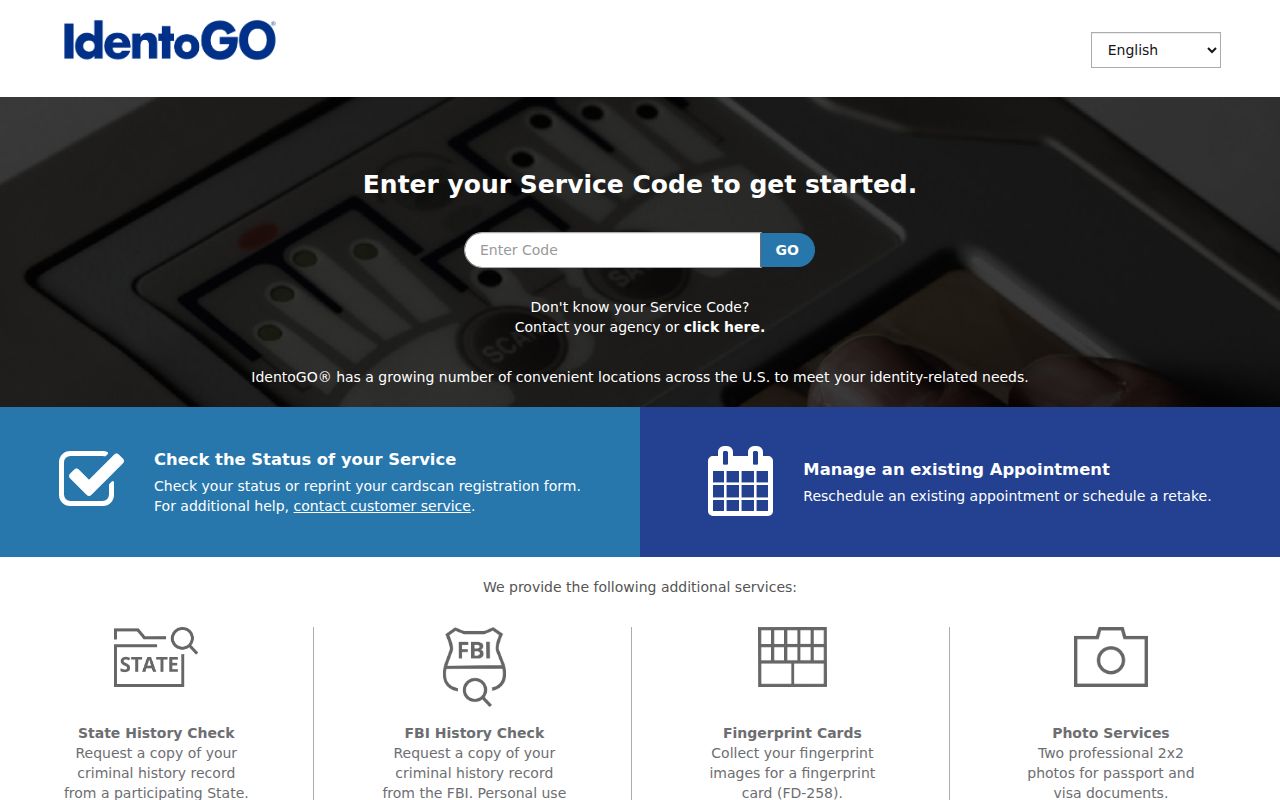
Because locations and appointment times change, the current enrollment result is more reliable than a saved address list.
Note: The 11FT12 code is for a Texas personal review and should not replace a separate authorized program's service code.
Comparing Texas DPS and County Records
Texas DPS CCH is a compiled statewide history. A Texas county file is the original local record. Neither replaces the other. The public Texas DPS product can find qualifying reported outcomes across Texas, while a fingerprint review links the subject to the fuller Texas history available through that process. A district or Texas county clerk can show the filed charge, docket activity, signed judgment, dismissal, sentence, and certified disposition. A jail or arresting agency holds still different material.
| Question | Texas DPS Check | County Record |
|---|---|---|
| Coverage | Reported CCH from statewide submissions | One Texas county and the proper local court or agency |
| Source | Linked arrest, prosecutor, court, and custody segments | Original docket, judgment, booking, or report |
| Timing | Can lag or miss a rejected or unmatched disposition | Updates as the local case moves |
| Detail | Structured rap-sheet fields | Documents, narrative, settings, and certified proof |
| Best Use | Statewide self-review or public statutory slice | Understanding and proving a specific case outcome |
Use the Texas county directory to locate the local half. Felony files generally sit with district clerks, Class A and B misdemeanor files with Texas county clerks, and fine-only matters with municipal or justice courts.
Texas DPS Record Boundaries
The Texas DPS public product is limited by Government Code Section 411.135. It releases qualifying convictions and deferred adjudications, plus associated arrest data that may lawfully become public. Fuller CCH begins as confidential under Section 411.083. The public result is also account-gated and paid. Expected fields come from the statute and CCH structure, but every detailed screen label was not observed without buying a private person's result.
Texas DPS cannot supply a clerk's PDF, full police narrative, victim identity, fingerprint image, Social Security number, or every nonconviction. It also cannot fix another jurisdiction's FBI contribution. A Texas expunction or nondisclosure order has specific legal effects, but the two remedies are not the same. Expunction directs covered records toward removal or obliteration; nondisclosure limits ordinary public release while preserving listed access.
For a public-information request, send it to the office that holds the desired report. A generic request to Texas DPS does not turn a Texas county docket or municipal police narrative into a Texas DPS record.
Texas DPS Record Error Corrections
Texas DPS Error Resolution corrects the state CCH file when proper source proof supports the change. Start by ordering your own fingerprint personal review. Identify whether the problem concerns identity, arrest facts, a missing disposition, or a cleared record. An ordinary portal screenshot is not enough to prove a court outcome.
- Obtain the CR-63 fingerprint personal review and mark the exact Texas DPS entry that appears wrong or incomplete.
- For arrest facts, ask the arresting agency for a correction on official letterhead. For an outcome, obtain a certified disposition from the court of jurisdiction.
- Complete the Texas DPS Error Resolution form with name, birth date, contact information, a clear account of the issue, and the source proof.
- Submit the packet to the Texas DPS Error Resolution Unit, then order a fresh personal review after processing to confirm the change.
The Texas DPS Error Resolution instructions distinguish arrest corrections, court proof, identity misuse, and FBI-source disputes.
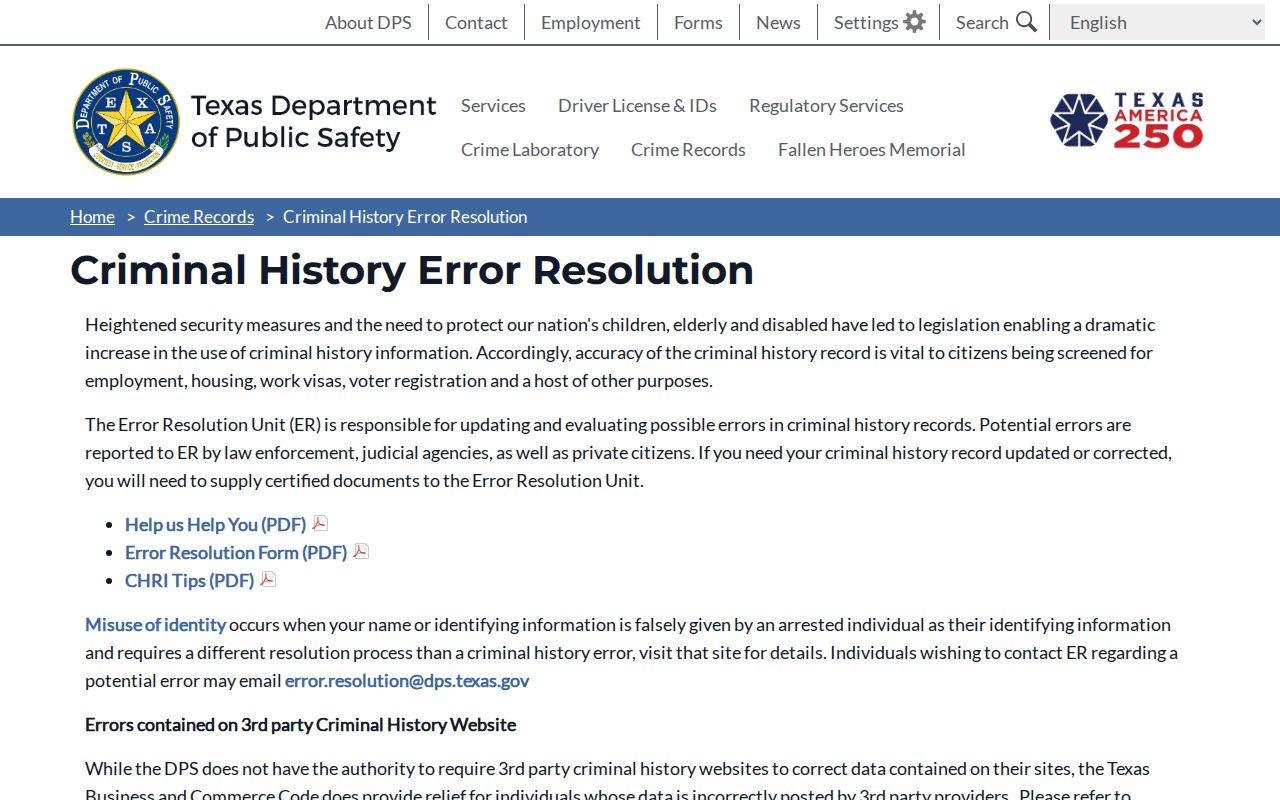
Certified local proof is the bridge between the originating case and the statewide correction.
Texas DPS After Record Relief
Texas expunction law now appears in Code of Criminal Procedure Chapter 55A, effective January 1, 2025. A qualifying order directs named agencies and entities to remove, return, delete, destroy, or obliterate covered information as the order requires. A nondisclosure order under Government Code Chapter 411 is different. It limits ordinary public dissemination but keeps access for agencies and entities named by law.
Relief starts in an authorized Texas county court, not at a statewide Texas DPS counter. After the order has had time to circulate, check the originating docket and then obtain a new fingerprint-based Texas DPS personal review. If CCH still carries a wrong disposition or identity link, use the certified court record in Error Resolution. The order and the accuracy challenge solve different problems.
Identity misuse also has a dedicated Texas DPS path. A person whose identifiers were used by someone else should follow the agency's identity-theft and error instructions instead of trying to explain the mismatch through repeated public name searches.
Note: Confirm relief in both the originating Texas case and a new fingerprint-based Texas DPS review after agencies have processed the order.