
How Texas Courts Handle Criminal Cases
Texas divides criminal work by offense level and place. District courts have original felony jurisdiction. Their records are kept by the elected district clerk. Constitutional Texas county courts and Texas county courts at law commonly hear Class A and Class B misdemeanors, though local statutes can alter the assignment. The Texas county clerk usually keeps those files. Municipal and justice courts handle many fine-only Class C cases. Their records sit outside the felony route. This split means that a name search in the wrong Texas court can return nothing even when a case exists elsewhere.
The Texas Judicial Branch trial-court overview maps these court levels and their jurisdiction.

The structure shown there is the first routing tool for a Texas court case lookup. It identifies the type of clerk likely to hold the docket, pleadings, signed judgment, and certified disposition.
Texas Criminal Case Portal Gap
Texas has no single public portal for every criminal trial case. The Texas Office of Court Administration says its Judicial Branch site does not maintain an all-trial-case search. District and Texas county matters must go to the clerk where filed. Texas municipal, justice, and appellate cases go to their own courts. That Texas court design is not a minor exception. It is the main path to Texas criminal court records.
OCA answers the statewide case-search question directly and points searchers back to the proper court.
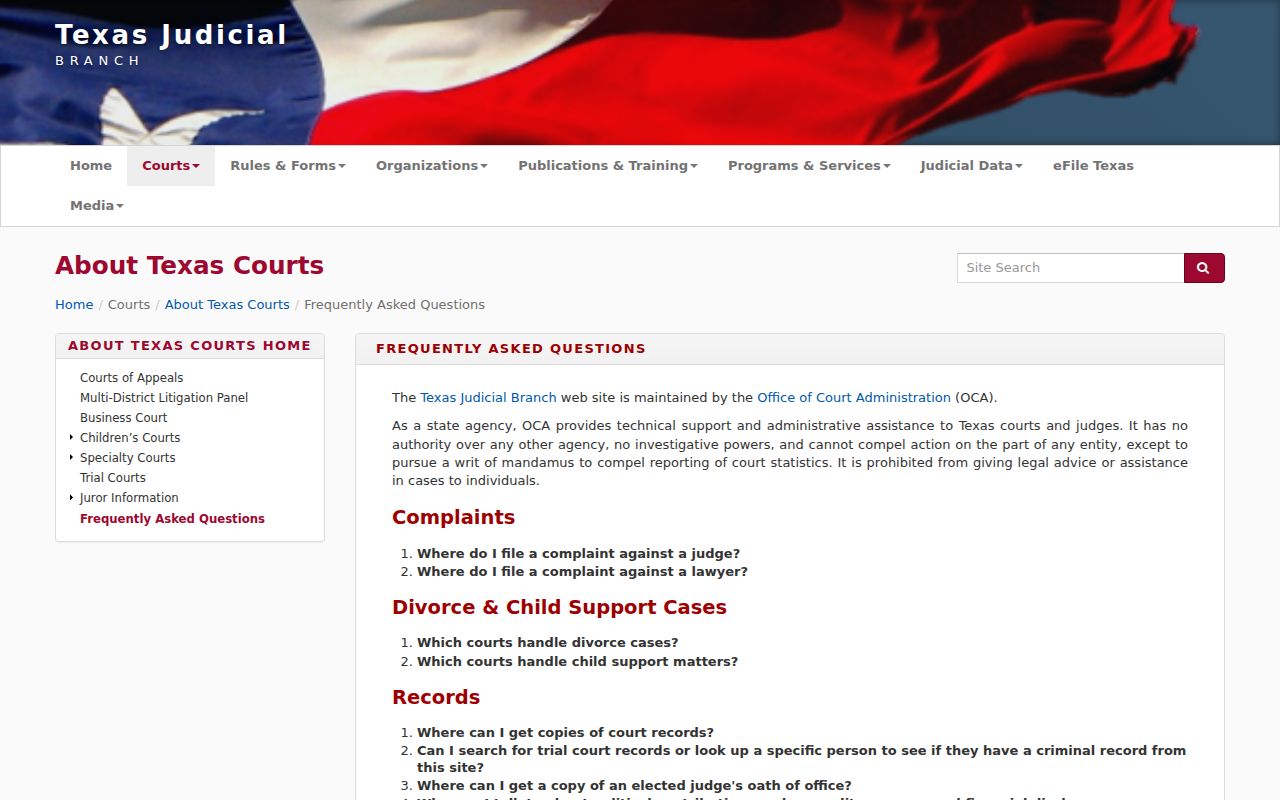
That limitation explains why geography, charge level, and court type matter as much as a person’s name. A missing statewide result is not proof that no Texas criminal case was filed.
Note: Texas trial-court searches begin with the filing court because no public state portal contains every criminal trial docket.
Running a re:SearchTX Search
re:SearchTX is statewide e-file infrastructure with case, hearing, filing, document, and alert tools. Yet a current Judicial Council data report says the public repository excludes criminal case records. It should not be presented as a comprehensive Texas criminal case search. Its controls are useful for supported public material, while a criminal inquiry still moves to the proper clerk.
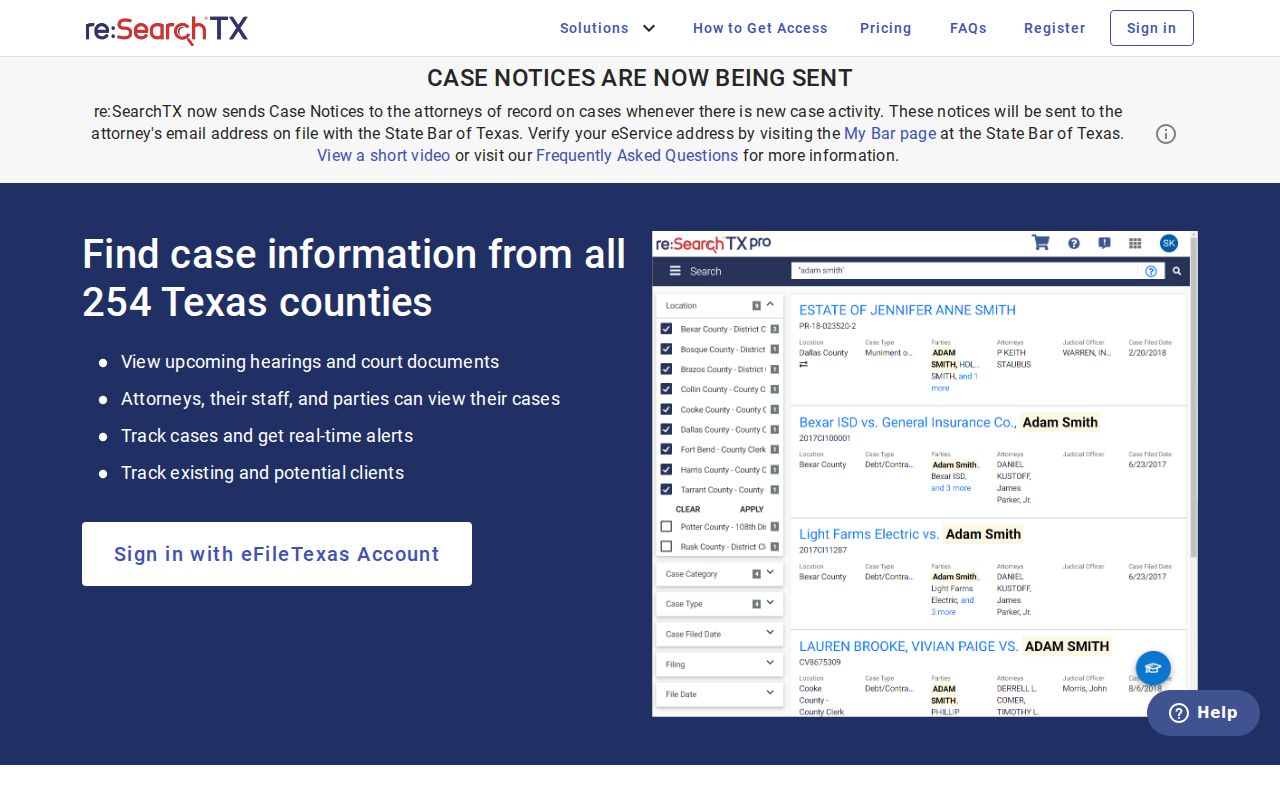
The portal image illustrates the statewide interface, but not a statewide criminal trial database. Use this five-step route for Texas criminal records:
- Identify the Texas county or city, the likely offense level, and an approximate filing date.
- Choose the Texas district clerk for a felony, the Texas county clerk for most Class A or B misdemeanors, or the municipal or justice court for a fine-only matter.
- Search by cause number when known. Otherwise, use the full name, date of birth if accepted, and name variants.
- Read the whole docket for charges, settings, orders, and a final disposition. A setting is not an outcome.
- Order the signed judgment, dismissal, supervision order, or certified disposition from the clerk when proof is needed.
| re:SearchTX control | Type | Required | Criminal-case note |
|---|---|---|---|
| Basic or Advanced Search | Search mode | No | Changes the supported public search controls. |
| Cases or Hearings | Tab | Yes | Current Texas public coverage still excludes criminal trial records. |
| Search By | Dropdown | Yes | Shows conditional text fields for the selected search method. |
| Party, attorney, or judge name | Text | No | Asterisk wildcards can expand first- or last-name matching. |
| Sort and export | Controls | No | Sort by date or case number and export supported results. |
Texas Criminal Charging Records
A Texas complaint is a sworn allegation that can support early proceedings or a fine-only case. A Texas information is a prosecutor-filed charging instrument used where Texas law permits, often for misdemeanors. A Texas indictment is the formal felony charge returned by a grand jury. A no-bill means the grand jury declined to indict the presented charge. It is not the same as a trial acquittal or the dismissal of a filed case.
These distinctions help a reader follow a case that changed after booking. The arrest charge may differ from the filed charge, and the charge at disposition may change again through plea or amendment. Texas court records should be read in sequence. The latest one-word status should never replace the signed order or judgment.
- Cause number
- The clerk’s identifier for the filed court case.
- Arraignment
- The proceeding where the accusation is addressed and a plea is entered.
- Disposition
- The result of a charge, such as conviction, dismissal, acquittal, or deferred adjudication.
- Capias
- A court order directing an officer to take a named person into custody.
What a Texas Case File Contains
A Texas criminal case file can identify the court, cause number, filing date, charge, parties, counsel, hearings, and outcome. It may also contain the complaint, information or indictment, motions, bond events, plea papers, orders, and judgment. Public document access varies. Images may be online, available for purchase, or limited to a clerk request. Sealed, nondisclosed, expunged, juvenile, and victim-sensitive material can be withheld or redacted.
| Case Number & Court | Identifies the clerk file, venue, and court assigned to the case. |
|---|---|
| Charging Documents | Shows the formal allegation after prosecutor or grand-jury action. |
| Docket Entries | Lists filings, settings, orders, bond events, and other court action. |
| Hearing Dates | Shows scheduled and completed events, but not always the result. |
| Disposition | Records conviction, deferred adjudication, dismissal, acquittal, or another final result. |
| Sentence & Judgment | States the signed outcome, sentence, supervision, fine, or confinement terms. |
The Texas court rules and access standards supply the statewide legal framework for judicial records.
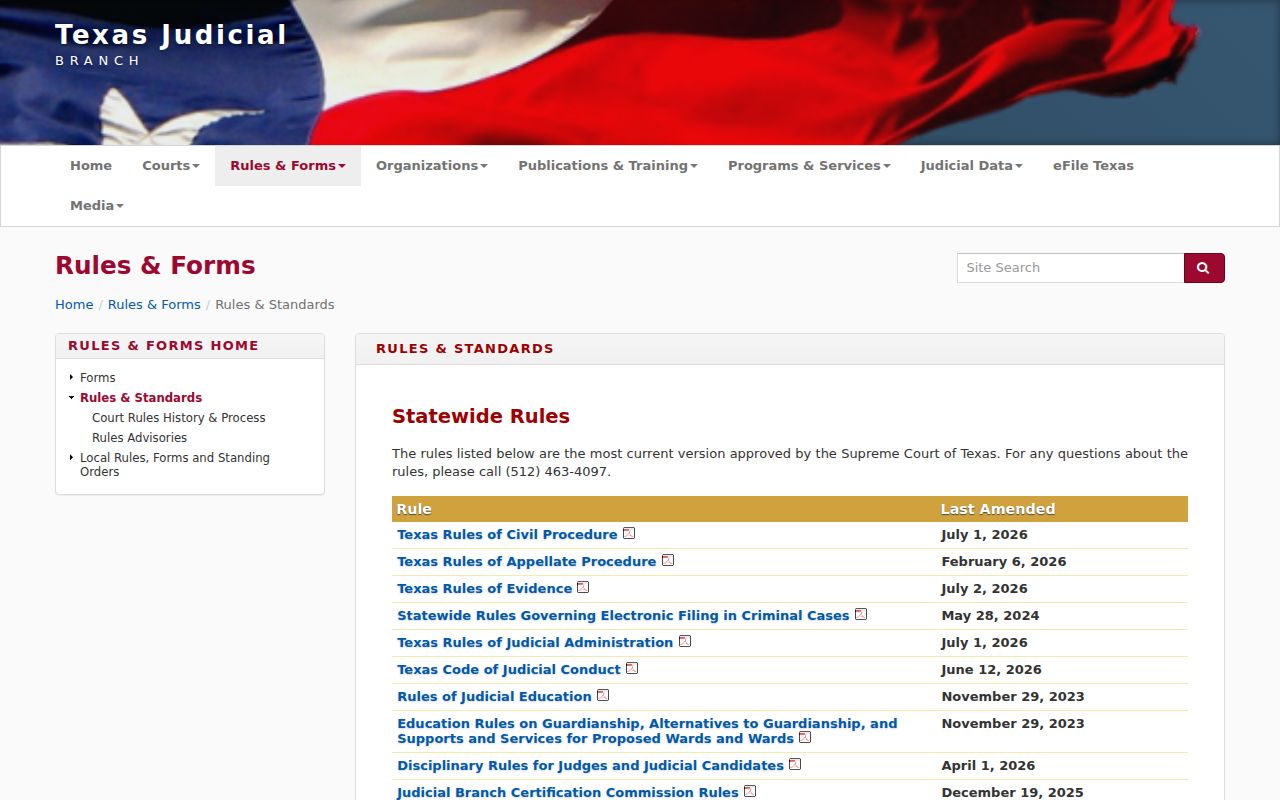
Case papers remain court records, not a copy of the Texas DPS rap sheet. The clerk file shows judicial activity. Texas DPS compiles reported criminal-history segments under a separate law and reporting process.
Note: A certified Texas disposition comes from the court clerk, even when Texas DPS displays a matching reported outcome.
Texas Criminal Case Status Terms
“Pending” means the Texas criminal case has not reached final disposition. It does not establish guilt. “Dismissed” means the filed charge ended without conviction, though the order may explain whether refiling or another condition matters. “Deferred adjudication” means the judge deferred a finding of guilt during community supervision. It is not a conventional conviction, yet reported deferred adjudication can appear in the public Texas DPS product unless later protected.
An acquittal follows a not-guilty result at trial. A no-bill is a grand-jury decision not to indict. A mistrial ends without a final verdict. “Reversed and remanded” means an appellate court returned the matter for more proceedings. Bond forfeiture is a bond-related event, not a disposition of the underlying accusation. Always open the related order when a Texas docket label is unclear.
A clerk status is an index clue. The signed Texas judgment, dismissal, or acquittal order supplies the stronger proof of outcome.
Texas Criminal Case Stages
A Texas criminal file often starts after an arrest or summons. Magistration follows, with warnings, counsel information, probable-cause review, and bail issues. Prosecutor review then determines the filed charge. Felonies ordinarily move through a grand jury. Arraignment and pretrial proceedings create plea, counsel, discovery, bond, suppression, competency, and scheduling entries. The case may end through plea, trial, dismissal, deferred adjudication, or another lawful route.
Case flow: Charges Filed › Arraignment › Pretrial › Plea or Trial › Disposition › Sentencing
A judgment is the signed declaration of the result and sentence. An appeal adds a separate appellate record. A notice, briefing, opinion, mandate, or post-conviction filing can explain why the trial docket later changes. Since each stage creates a different record, a Texas court case lookup should not stop at the first visible entry.
Note: A scheduled hearing or trial date is a calendar event, not proof that the Texas case ended that day.
Texas County Criminal Portal Differences
Local Texas portals use different fields, rules, and document systems. A representative district-clerk interface may offer party name, date of birth, cause number, court, filing date range, status, offense type, docket date, or bondsman information. Search hints may require a cause number without punctuation or a last-name-first format. Older files can require a paid information search, a counter request, mail, or a call to the clerk.
The official local document-search hints used in the Texas research sample show how exact formatting affects results.
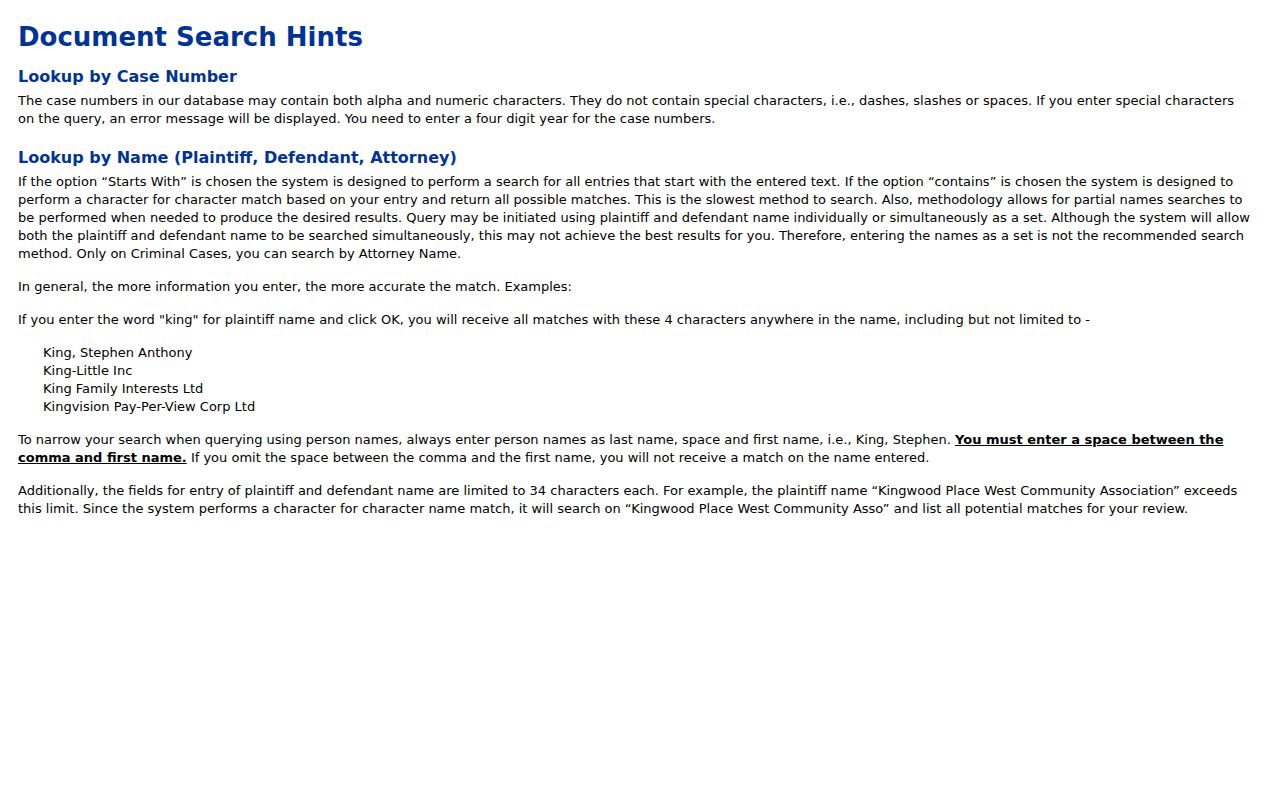
Those sample rules should not be assumed statewide. They demonstrate why each clerk’s own help text matters. Search methods, registration, image access, and copy charges can differ across all 254 Texas counties.
Note: Preserve the exact Texas cause number once found because it is safer than repeating a broad name search.
Texas Criminal Case Appeals
Texas has fourteen regional Courts of Appeals that hear ordinary criminal appeals. The Court of Criminal Appeals is the state’s court of last resort for criminal matters. It handles discretionary review, direct death-sentence appeals, and felony post-conviction habeas authority. The Fifteenth Court of Appeals has specified statewide civil jurisdiction and is not the normal criminal-appellate destination.
Appellate records can clarify whether a conviction was affirmed, reversed, or sent back. Search the regional appellate court after locating the trial cause number and Texas county. Then look for the mandate, because that document returns the appellate result to the trial court. A complete Texas criminal case history may require both records.
County Sources for Texas Case Records
The original Texas case file stays with the court that heard it. District clerks hold felony district-court files. County clerks commonly hold Class A and B misdemeanor files, subject to local court structure. Municipal and justice clerks keep their own fine-only cases. A written request should identify the person, cause number if known, approximate date, and documents wanted. Ask for a certified disposition when proof of the outcome is needed to correct a Texas DPS record.
The representative official Texas county search captured for the research shows the type of local criminal docket interface a Texas clerk may provide.
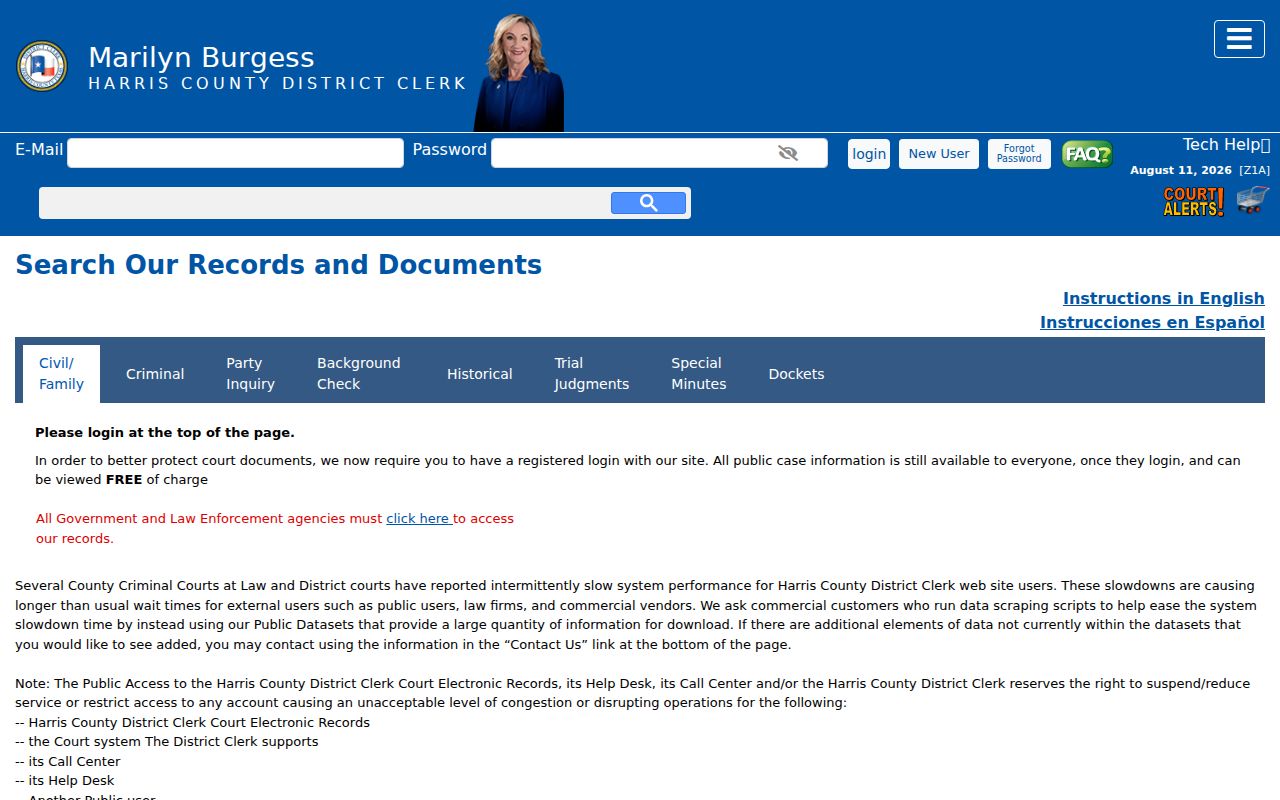
That portal is illustrative, not statewide. Browse the directory of all 254 Texas counties to reach the right local records site. For a statewide reported conviction or deferred-adjudication view, compare the court file with Texas DPS criminal history checks. Neither source replaces the other.